Pages

Popular Posts

Showing posts with label frequently asked questions. Show all posts

4.23.2014

Journey into Nyx Release Notes

~
Happy Wednesday MTG peeps,

Today over on the mothership, the WotC crew posted Journey into Nyx Release Notes.  We were expecting as well today to have the new set also uploaded to the Gatherer Card Database, but apparently not.  Something odd did happen earlier today -  it appears that the mothersite was down - perhaps this was an issue with promoting the new database (?).  Anywhoos, things did indeed get set back in to order eventually.  Ahead of your Journey into Nyx PreRelease Event, we suggest reading over the Release Notes with an eye to the individual card notes to ensure your event goes smoothly and hopefully no confusion as what a particular card may or may not do.  Here's a brief overview -
~
Release Information
The Journey into Nyx set contains 165 cards (60 common, 60 uncommon, 35 rare, and 10 mythic rare).

Prerelease events: April 26–27, 2014
Launch Weekend: May 2–4, 2014
Game Day: May 24–25, 2014

The Journey into Nyx set becomes legal for sanctioned Constructed play on its official release date: Friday, May 2, 2014. At that time, the following card sets will be permitted in the Standard format: Return to Ravnica, Gatecrash, Dragon's Maze, Magic 2014, Theros, Born of the Gods, and Journey into Nyx.

Returning Ability Words
Bestow, Heroic, Inspired, Scry, Monstrosity and Devotion


New Ability Word - Constellation
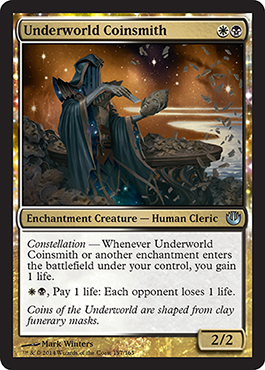
An enchantment's constellation ability triggers every time it or another enchantment enters the battlefield under the player's control. Most of the enchantments with constellation abilities in Journey into Nyx are enchantment creatures, but not all of them. 


New Ability Word - Strive
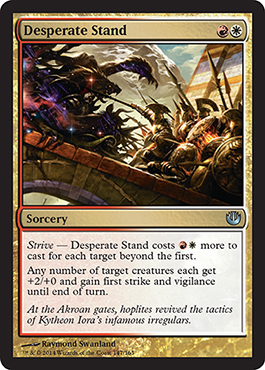
Strive is an ability word introduced in Journey into Nyx, where it is connected to the hero theme of the block. A spell with a strive ability lets you pump more mana into it to increase the number of targets. Similar abilities had been featured before on cards like Fireball and some multikicker cards in Zendikar block.  As you cast a spell with strive, you can choose any number of targets, paying an additional cost for each target beyond the first.


~
Of particular note with regards to some of the card specific notes is the wording on Banishing Light which is very similar to that of Oblivion Ring.  The rewording sidesteps some of the crazy perma-exile and / or infinite loop shenanigans which Oblivion had allowed.

Jumping straight to the end of the Release Notes is a monster of a individual card note for the new black sorcery, 'Worst Fears'.  Check out this behemoth -

We'll just read that bit about Worst Fears latter.
:)
~

7.10.2013

M14 FAQ

~
Happy Wednesday MTG peeps,

This is our second post for the day.  If you missed our first post about the Magic 2014 PreRelease, click on over here.

In this post, we wanted to let Magic: the Gathering players including those heading off to the PreRelease event this weekend to pop on over to the Mothersite and get in a quick review of the Magic 2014 FAQ document. 

Here's a quick 'n' dirty summary without getting into the card specific notes -
~

Magic 2014 Frequently Asked Questions
Wizards of the Coast, Tuesday, July 09, 2013

GENERAL NOTES

Release Information
The Magic 2014 core set contains 249 cards (101 common, 60 uncommon, 53 rare, 15 mythic rare, and 20 basic land).

Prerelease events: July 13–14, 2013
Launch Weekend: July 19–21, 2013
Game Day: August 10–11, 2013

The Magic 2014 core set becomes legal for sanctioned Constructed play on its official release date: Friday, July 19, 2013. At that time, the following card sets will be permitted in the Standard format: Innistrad, Dark Ascension, Avacyn Restored, Magic 2013, Return to Ravnica, Gatecrash, Dragon's Maze, and Magic 2014.

~
Returning Theme: Slivers
Magic 2014 features the return of creatures with the creature type Sliver. These popular creatures share abilities or power and toughness bonuses with other Slivers you control.

Cycle: Magus Staffs
This set also includes a cycle of artifacts, each aligned to a color, that allow you to gain life for casting spells of that color or having basic lands of the type associated with that color enter the battlefield.

Returning Card Type: Planeswalkers
A planeswalker is a powerful ally who fights by your side. With the exception of the "planeswalker uniqueness rule" (see the separate section below), the rules for planeswalkers have not changed with this release.

~
Rule Change: The "Planeswalker Uniqueness Rule"
Previously, if there were two or more planeswalkers that share a subtype (such as "Jace") on the battlefield, they would all be put into their owners' graveyards as a state-based action. This rule is changing. The new rule is as follows:

704.5j If a player controls two or more planeswalkers that share a planeswalker type, that player chooses one of them and the rest are put into their owners' graveyards. This is called the "planeswalker uniqueness rule."


Rule Change: The "Legend Rule"
Although there are no legendary permanents in the Magic 2014 Core Set , the "legend rule" is changing along with this set. Under the previous rule, whenever two or more legendary permanents with the same name were on the battlefield, they were all put into their owners' graveyards as a state-based action. This rule is changing to the following:

704.5k If a player controls two or more legendary permanents with the same name, that player chooses one of them and the rest are put into their owners' graveyards. This is called the "legend rule."

New Keyword: Indestructible
Indestructible is a new keyword for an existing ability.

~
CARD-SPECIFIC NOTES
Just over 90 card specific notes from Academy Raider . . . Young Pyromancer.


~

4.22.2013

Dragons Maze FAQ

~
Happy Monday MTG peeps,

A happy Monday indeed as Magic: the Gathering players now have the entire list of the latest card set, Dragon's Maze.  Today on the mothersite, the remaning cards were loaded up on the Dragon's Maze Visual Spoiler page.  All 156 Dragon's Maze cards have now also been posted on MTG Mint Card as well which means we can finalise our pre-orders.  We've already got our name on a list for the prerelease at OMG! Games here in Barrie, Ontario and we suggest you talk to your local games store for arrangements.  For today's post, we want to provide a summary of the Dragon's Maze (FAQ) Frequently Asked Questions document.  Drop by the mothersite for the full document.


Release Information
The Dragon's Maze set contains 156 cards (70 common, 40 uncommon, 35 rare, and 11 mythic rare). In lieu of a basic land card, each Dragon's Maze booster pack has a nonbasic land card, which can be one of the ten Dragon's Maze Guildgates, one of the ten Return to Ravnica or Gatecrash dual lands with basic land types, or the mythic rare Dragon's Maze card Maze's End.

Prerelease events: April 27–28, 2013
Launch Weekend: May 3–5, 2013
Game Day: May 25–26, 2013 


Reprinted cards - Guildgates, Feral Animist, Putrefy, Wind Drake.

Shocklands - All ten 'shocklands' from Return to Ravnica and Gatecrash are included within Dragon's Maze but are printed with thier original set symbol and are not considered reprints.


New Mechanic: Split Cards with Fuse
Split cards, featured prominently in the original Ravnica block, are back with a new twist: the fuse ability.  All split cards have two card faces on a single card. You can choose which half of the card you want to cast, pay that half's mana cost, and only that half will go on the stack. The characteristics of the half of the card you didn't cast are ignored while the spell is on the stack.  Fuse introduces a third option if you're casting a Dragon's Maze split card from your hand: cast the entire card as a single spell by paying both of its mana costs.

Returning Mechanics: Guild Keywords, Keyword Actions, and Ability Words
Return to Ravnica: detain (Azorius), overload (Izzet), unleash (Rakdos), scavenge (Golgari), and populate (Selesnya)
Gatecrash: extort (Orzhov), cipher (Dimir), bloodrush (Gruul), battalion (Boros), and evolve (Simic)


Cycle: Guildgates

The Dragon's Maze set includes a cycle of nonbasic lands with the subtype Gate. Each guild has a Gate card with Guildgate in its name that taps for mana of either of that guild's colors. These cards were previously printed in the Return to Ravnica and Gatecrash sets; they appear here with new art. 


Cycle: Gatekeepers
The Dragon's Maze set includes a cycle of Gatekeepers with enters-the-battlefield abilities that give you a bonus for controlling two or more Gates.

Cycle: Cluestones
There are one of these common artifacts for each Guild with a casting cost of 3.  They tap for either of that guild's mana or pay one of each guild mana and sacrifice to draw a card.

Cycle: Guild Champions
There are ten of these rare legendary creatures, one for each Guild.  They are Emmara Tandris (Selesnya), Exava, Rakdos Blood Witch (Rakdos), Lavinia of the Tenth (Azorious), Mirko Vosk, Mind Drinker (Dimir), Melek, Izzet Paragon (Izzet), Ruric-Thar, The Unbowed (Gruul), Tajic, Blade of the Legion(Boros), Teysa, Envy of Ghosts (Orzhov), Varolz, the Scar-Striped (Golgari), and Vorel of the Hull Clade (Simic).

Cycle: Uncommon Fuse Spells
There are ten of these split cards featuring the new fuse mechanic which feature a different monocolour spell on each side. These are Protect/Serve (Azorius), Far/Away (Dimir), Toil/Trouble (Rakdos), Armed/Dangerous (Gruul), Alive/Well (Selesnya), Profit/Loss (Orzhov), Down/Dirty (Golgari), Give/Take (Simic), Turn/Burn (Izzet) and Wear/Tear (Boros).

Cycle: Rare Fuse Spells
There are five of these split cards featuring the new fuse mechanic which feature a different multi-colour spell on each side.  These are  Beck/Call (Simic/Azorius), Breaking/Entering (Dimir/Rakdos), Flesh/Blood (Golgari/Gruul), Catch/Release (Izzet/Boros), and Ready/Willing (Selesnya/Orzhov).
~

9.26.2012

RTR FAQ

~
Happy Wednesday MTG peeps,

The newest Magic the Gathering set, Return to Ravnica will be hitting game tables around the world shortly after midnight this Friday 28th September and officially launched the next weekend (5th October, 2012).  With the new set, there are always questions to be had.  To this end, we here at MTG Realm want to bring to your attention, the Return to Ravnica Frequently Asked Questions (linky here) documents which, if reviewed, should make your PreRelease play more effecient and more enjoyable.  Speaking of the PreRelease, if you do not know where you can go to game, click on over to locator.wizards.com to find a store near you.  Also make sure to peruse the selection of Return to Ravnica english / chinese singles, foils and sets at MTG Mint Card.

Anywhoos - onto the FAQs . . .

~
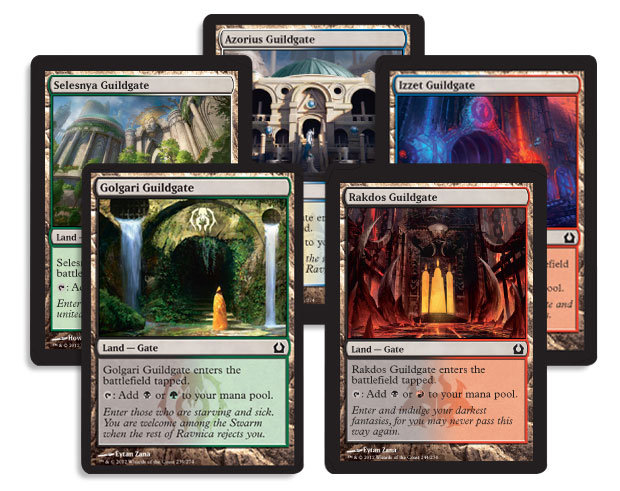
Cycle: Guildgates
The Return to Ravnica set introduces a new land subtype: Gate. Each guild has a Gate card with Guildgate in its name that taps for mana of either of that guild’s colors.  Gate is not a basic land type.

~
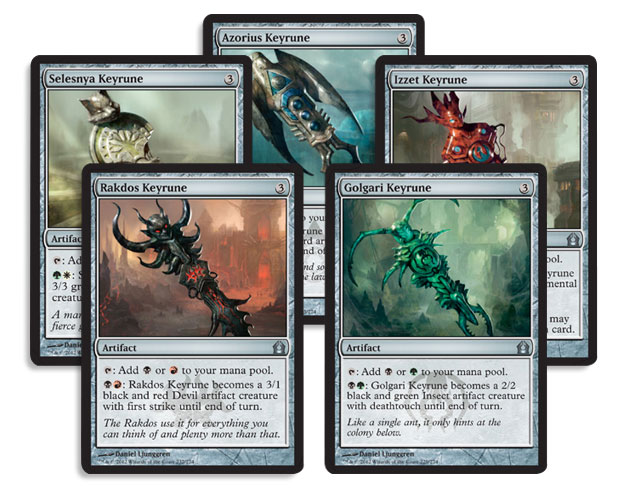
Cycle: Keyrunes
Each guild has a Keyrune, an artifact that taps for mana of either of that guild’s colors and can become a creature.  Until the ability that turns the Keyrune into a creature resolves, the Keyrune is colorless.

~
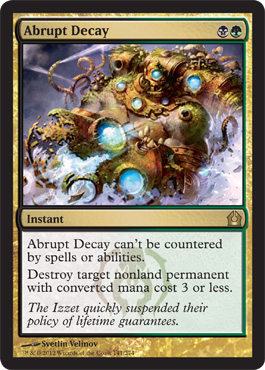
Cycle: Cards that “Can’t Be Countered”

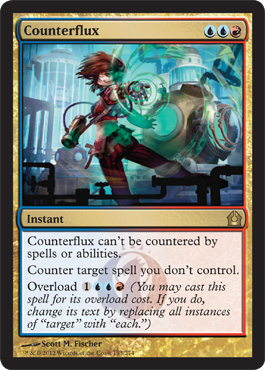
The Return to Ravnica set includes a cycle of cards that can’t be countered.  Each of these rare multicolored spells with the ability to not be (conventionally) countered. A spell that can’t be countered by spells or abilities can be targeted by spells and abilities that try to counter it.

~
Returning Themes: Guilds and Guildmarks
If a card in the Return to Ravnica set is associated with a guild, it features the appropriate guildmark in the background of its text box. These guildmarks have no effect on game play.

~
Returning Mechanic: Hybrid Cards

These are cards with Hybrid mana costs.  Each hybrid mana symbol represents a cost which can be paid with one of two colors. The hybrid mana symbol can be of any combination of two colors, or any color of mana and two generic mana.

~
Returning Cycle: Ravnica “Dual Lands”
There are five nonbasic lands in the Return to Ravnica set that each have two basic land types - Blood Crypt (b/r), Hallowed Fountain (w/), Overgrown Tomb (b/g), Steam Vents (u/r), and Temple Garden (g/w).

~
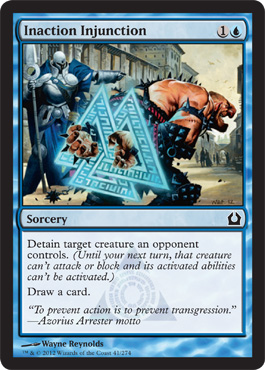
Azorius Keyword Action: Detain

Reminder text on these cards are 'Until your next turn, that creature can’t attack or block and its activated abilities can’t be activated.'  Activated abilities include a colon and are written in the form “[cost]: [effect].  If a creature is already attacking or blocking when it’s detained, it won’t be removed from combat.  If a noncreature permanent is detained and later turns into a creature, it won’t be able to attack or block.

~
Izzet Keyword: Overload

Reminder text here is 'You may cast this spell for its overload cost. If you do, change its text by replacing all instances of “target” with “each.”.  If you don’t pay the overload cost of a spell, that spell will have a single target. If you do pay the overload cost, the spell won’t be 'targetting' meaning it can get around 'hexproof' critters (can't be the target of spells and abilities).

~
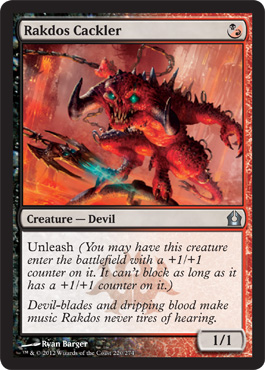
Rakdos Keyword: Unleash

These cards will have the text 'You may have this creature enter the battlefield with a +1/+1 counter on it. It can’t block as long as it has a +1/+1 counter on it.'  You make the choice to have the creature with unleash enter the battlefield with a +1/+1 counter or not as it’s entering the battlefield. At that point, it’s too late for a player to respond to the creature spell by trying to counter it, for example.  Putting a +1/+1 counter on a creature with unleash that’s already blocking won’t remove it from combat. It will continue to block.

~
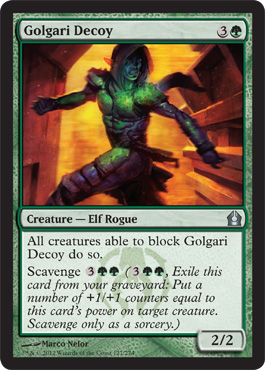
Golgari Keyword: Scavenge

These will have text with 'Scavenge (Cost ?) - (Cost ?, Exile this card from your graveyard: Put a number of +1/+1 counters equal to this card’s power on target creature. Scavenge only as a sorcery.)'.  Somewhat similar to the flashback mechanic.

~
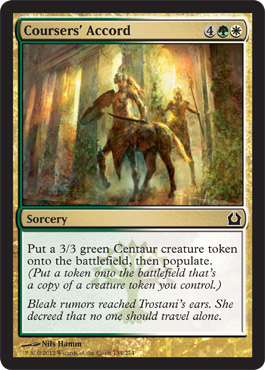
Selesnya Keyword Action: Populate

The reminder text will be 'Put a token onto the battlefield that’s a copy of a creature token you control.'.  You can choose any creature token you control. If a spell or ability puts a token onto the battlefield under your control and then instructs you to populate (as Coursers’ Accord does), you may choose to copy the token you just created, or you may choose to copy another creature token you control.  If you control no creature tokens when instructed to populate, you won’t put a token onto the battlefield.
~
Also - there is a large section with card specific rules / notes / explanations within the document, look here to find a card which you may have questions about.

~

9.19.2011

Innistrad FAQ

~
Happy Tuesday Evening MTG peeps,

In this post, we give you the quick and dirty crash course on the upcoming Magic the Gathering set by summarising the
Innistrad Frequently Asked Questions document. The original is posted on the mothership here.
~

Innistrad contains 264 cards (107 common, 67 uncommon, 59 rare, 16 mythic rare, and 15 basic lands.

Prerelease events: September 24-25, 2011


Launch Parties: September 30-October 3, 2011


Innistrad set becomes legal for sanctioned Constructed play on its official release date: Friday, September 30, 2011.
At that time, the following card sets will be permitted in the Standard format: Scars of Mirrodin, Mirrodin Besieged, New Phyrexia, Magic 2012, and Innistrad.

~
Innistrad FAQ
~
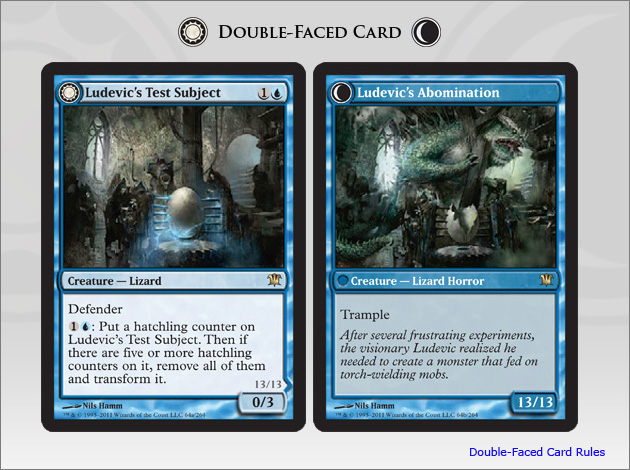
New Card Layout: Double-Faced Cards
New Keyword Action: Transform

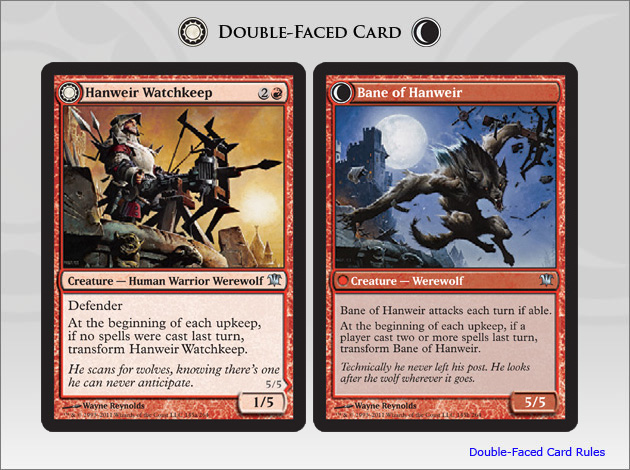
There are 20 Innistrad cards have two faces: a front face and a back face. A new keyword action, transform, allows you to turn the card over to its other face under certain conditions. The front face of the card has a sun symbol in its upper left corner. The back face has a moon symbol in its upper left corner. While Double-Faced Cards are in public zone, each player may look at both faces and is always cast face up.

Transforming a Double-Faced permanent doesn't affect any Auras or Equipment attached to that permanent. Similarly, any counters on the permanent will remain on that permanent after it transforms. Similarily, damage marked on a double-faced permanent will stay marked on that permanent after it transforms.

~
Theme: Double-Faced Werewolves

There are 12 Innistrad cards which can transform from a human-werewolf into a full werewolf given a triggered ability that may transform it. Similarly, each back face has the same triggered ability that may transform it back.

~
Characteristic: Color Indicator
Double-faced Innistrad cards have a small dot to the left of its type line. This circular symbol is its "color indicator."

~
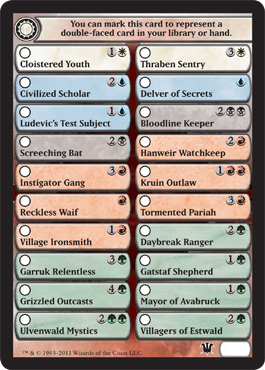
Game Supplement: Checklist Cards

Cards in your deck be indistinguishable from one another. To accomplish this with double-faced cards, you can use the checklist cards which are included in some booster packs. Fat Packs will contain ten checklist cards.

~
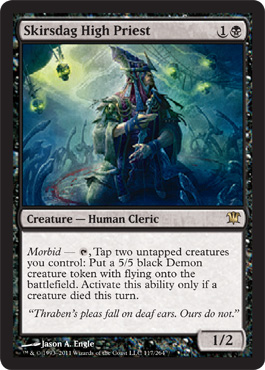
New Ability Word: Morbid

Morbid abilities, found on some creature, instants and sorceries cards check whether a creature died earlier in the turn. It's important to remember that Token creatures can also die, going to their owner's graveyard before ceasing to exist.

~
Returning Keyword Ability: Flashback

Flashback appears on some instants and sorceries. It represents two static abilities: one that functions while the card is in a player's graveyard and the other that functions while the card is on the stack. "Flashback [cost]" means "You may cast this card from your graveyard by paying [cost] rather than paying its mana cost" and "If the flashback cost was paid, exile this card instead of putting it anywhere else any time it would leave the stack."

~
New Subtype: Curse

There are six Auras in Innistrad which can enchant a player that could have a negative effect for that enchanted player. These enchantments have the additional subtype "Curse."


~
Theme: Vampires with +1/+1 Counters

There are four Vampire creature cards in Innistrad that puts puts one or more +1/+1 counters on the creature when they deal combat damage to your opponent. The +1/+1 counter isn't put on the creature in time to increase the amount of combat damage dealt during that combat step.

~
New Keyword Action: Fight

To fight, each of the indicated creatures simultaneously deals damage equal to its power to the other specified creature.

~
Cycle: Enemy "Tap Lands"

Innistrad has a cycle of lands that produce two colors of mana and enter the battlefield tapped unless you control a certain land.


~

And now a word about jumping on this upcoming set - we're suggesting getting in your pre-orders ahead of the official release on September 30th next month. Check out the excellent prices at MTG Mint Card here.
~

5.04.2011

NPH FAQ Document

~
Happy Wednesday MTG peeps,

If you are heading out to a New Phyrexia pre-release, we suggest you set some time aside to review again our New Phyrexia spoiler list to evaluate top picks for your sealed pool. As well, you will be well-served should you read the Frequently Asked Questions document containing clarifications and rulings for the new cards. This will ensure that you will limit or eliminate a potentially embarassing faux-pas when slinging the new cardboard. Secondly, this should also help your game progress in an expeditious manner.


Anywhoos - here is the New Phyrexia Document

New Phyrexia FAQ Document


~

For an easier to read html version of the FAQ document, head on over to the mothership where they have a a lovely page put up along with graphics of the cards.

~
Be sure to drop by MTG Realm again as we go crazy with the Cheez Whiz and bring you more posts and VIDEOS of the all the pre-release madness. For now, ensure you know your vital stats to get you to the event . . .

Release Information

The New Phyrexia set contains 175 cards (60 common, 60 uncommon, 35 rare, 10 mythic rare, and 10 basic land).

Prerelease events: May 7-8, 2011
Launch Parties: May 13-15, 2011

The New Phyrexia set becomes legal for sanctioned Constructed play on its official release date: Friday, May 13, 2011.

~

1.26.2011

Mirrodin Besieged FAQ

~
The Mirrodin Besieged Frequently Asked Question (FAQ) document has just been posted. We suggest you give it a review and set to have some fun playing in the pre-release this weekend and the release next weekend.

Some template information :
The set contains 155 cards (60 common, 40 uncommon, 35 rare, 10 mythic rare, and 10 basic land).
Prerelease events: January 29-30, 2011
Launch Parties: February 4-7, 2011
The Mirrodin Besieged set becomes legal for sanctioned Constructed play on its official release date: Friday, 4th 2011.

Mirran and Phyrexian Factions
The war rages on. Each Mirrodin Besieged card (except planeswalkers and basic lands) has an identifying insignia in its text box that shows which faction it belongs to. (The Mirran insignia looks like a segmented ring. The Phyrexian insignia looks like a circle with a slash through it.) Faction insignias have no effect on game play.

And onto the new keyword techs and other info . . .

New Keyword Ability: Battle Cry
Found on Mirran creatures, battle cry is an ability that grants a +1/+0 bonus to other attacking creatures.

New Keyword Ability: Living Weapon
Living weapon is an ability of Phyrexian Equipment that automatically provides a creature to wield the Equipment when it enters the battlefield.

Cycle: Zeniths
The Mirrodin Besieged set includes a cycle of five Zeniths, powerful spells that can be drawn multiple times over the course of a game.

Returning Scars of Mirrodin Mechanics
Many abilities and mechanics featured in the Scars of Mirrodin set return in the Mirrodin Besieged set. For more information about infect, -1/-1 counters, poison counters, imprint, metalcraft, and proliferate, check out the previous FAQ document.
Mirrodin Besieged FAQ
~

If you're looking for a great on-line retailer whom you can put in your Mirrodin Besieged pre-orders, give MTG Mint Card a try.

~

9.24.2010

Scars of Mirrodin FAQ

~
We recommend you have a look through the Scars of Mirrodin Frequently Asked Questions document before you head out to a pre-release or release / launch party event in order to appear like the smartest player there - it may even make your games more effective.

Release Information
The Scars of Mirrodin set contains 249 cards (101 common, 60 uncommon, 53 rare, 15 mythic rare, and 20 basic land).
Prerelease events: September 25-26, 2010
Launch Parties: October 1-3, 2010
The Scars of Mirrodin set becomes legal for sanctioned Constructed play on its official release date: Friday, October 1, 2010.

Scars of Mirrodin FAQ

Returning Theme: -1/-1 Counters
Many cards in the Scars of Mirrodin set put -1/-1 counters on creatures or care about -1/-1 counters in other ways. Infect appears only on cards from the Phyrexian faction.

Returning Theme: Poison Counters
A player who has ten or more poison counters loses the game. This is a state-based action. No Scars of Mirrodin cards enable a player to lose poison counters. (Only one card in the entire game -- the Homelands_(TM) card Leeches -- allows this to happen.) Unless you're playing a format in which Leeches is legal, once a player gets a poison counter, he or she will have it for the rest of the game.

New Keyword Ability: Infect
Infect is an ability that changes the nature of damage dealt to players and creatures. Only cards from the Phyrexian faction have infect. Infect (This creature deals damage to creatures in the form of -1/-1 counters and to players in the form of poison counters.)

Returning Ability Word: Imprint
Though originally printed in the Mirrodin block as a keyword, imprint is now an ability word. It appears in italics at the beginning of abilities, calling attention to permanents that exile other cards and then use the exiled cards' characteristics to define their other abilities. (An ability word has no rules meaning.) Imprint appears only on cards from the Mirran faction.

New Ability Word: Metalcraft
Metalcraft is an ability word. It appears in italics at the beginning of abilities that improve if you control three or more artifacts. (An ability word has no rules meaning.) Metalcraft appears only on cards from the Mirran faction.

New Keyword Action: Proliferate
Proliferate is a keyword action that appears on Phyrexian cards. It allows you to add another counter to each player and/or permanent that already has one.

Emblems and the Command Zone
An emblem is a new type of object that exists in the command zone. The command zone is a game area reserved for certain specialized objects, such as nontraditional _Magic_ cards (vanguard, plane, and scheme cards). Like all objects in the command zone, emblems aren't permanents and can't be destroyed.

Cycle: Spellbombs
The Scars of Mirrodin set includes a cycle of five Spellbombs, a variation of a cycle originally seen in the _Mirrodin(R)_ set. The second ability triggers when the Spellbomb is put into a graveyard from the battlefield for any reason, not just as a result of sacrificing it to activate its first ability.

Cycle: Smiths
The Scars of Mirrodin set includes a cycle of five Smiths, each of which is a creature with an ability that triggers whenever you cast an artifact spell. Whenever you cast an artifact spell, the ability of each Smith you control triggers. You can put the abilities on the stack in any order, keeping in mind that the one you put on the stack last will resolve first. All of the abilities will resolve before the artifact spell does.

Cycle: Scars of Mirrodin Tap Lands
The Scars of Mirrodin set includes a cycle of five lands that produce two colors of mana and enter the battlefield tapped unless you control two or fewer other lands.
~

8.31.2010

SoM Spoilers 8-31

~
Good Day MTG peeps,

We have some incredible Scars of Mirrodin spoilers for you right now. These are from a source who had the pleasure of translating the Scars of Mirrodin Frequently Asked Questions document.

Unfortunately, the translations are not all that clear (original Japanese post is below) so please do not take everything quite literally. Also - these are unconfirmed spoilers and we strongly caution you to rely only on the official previews from Wizards of the Coast. The original post did have an April 1st date (April's Fool's) in there but wow, quite elaborate not to be passed over without an evaluation. Original source found here.

~
Excerpts From "Scars of Mirrodin" Frequently Asked Questions

Keyword power reprinted: Affinity
Affinity is the ability first appeared in Mirrodin block. It is the ability to reduce the cost of spells, can have any type of card that can cast a spell.

Perpetual Invocation (7)(w)
Sorcery
Affinity (This spell costs 1 less to cast for each artifact you control.)
Exile target permanent

Achromatic Cloak (3)(g)
Enchantment - Aura
Affinity
(This spell costs 1 less to cast for each artifact you control.)
Echant creature
Each time you cast a colorless
spell , enchanted creature +3 / +3 until end of turn.

Keyword reprinted: Entwine
Entwine is the ability first appeared in Mirrodin block. It is written in the form of extra cost, can have any spell with the mode.

Tel-Jilad Command (2)(g)(g)
Choose two of the following:
Return target permanent card in a graveyard to its owner's hand.
Find a basic land card in your library and put that card into play tapped. shuffle your library.
Target creature gets +4 / +4 until end of turn.
Entwine (2)

Keyword power reprinted: fortified
Fortify first appeared on one "Future Sight" card - "Darksteel Garrison".

Darksteel Bunker (2)
Artifact
Tap target creature whenever you fortfy a land.
Fortified (4) : (4: Attach to target land you control. Fortify only as a sorcery.

Keyword Ability: Achroma
Clearsteel Cylix (2)
Artifact
Achroma
(T): add one mana of any one color to your mana pool.


Motorized Soldiers (2)
Artifact
Achroma
(2): until end of turn, Motorized Soldier become a 3/4 Artifact Golem Creature.

Keyword Ability: Eclipse
Eclipse is applied when the spell is the permanent solution is the ability counterpart.

Albino Vorrac (5)
Artifact Creature - Beast
Eclipse (single color for each one paid for the mana cost of this comes into play in -1/-1 counters on it. At the beginning of your upkeep, you (X) to may pay. Otherwise, this sacrifice. X is placed on top of which is equal to the number of -1/-1 counters.)
5 / 5

Clearsteel Flail (4)
Artifact - Equipment
Eclipse (single color for each one paid for the mana cost of this consumption comes into play in counters on it. At the beginning of your upkeep, you (X) may pay the . Otherwise, this sacrifice. X is placed on top of this consumption is equal to the number of counters.)
Equipped creature gets +2 / +2 for.
Equipment (X) X Clearsteel Flail is being placed on the number of counters equal to consumption.

~
Artifact Planeswalker

"Scars of Mirrodin" contains a "Artifact Planeswalker" card with the artifact in its type line. These are permanent, and artifacts as well as a planeswalker. They are an appropriate target for the effects of artifact affinity (artifacts), ability to count them as artifacts. "Artifact Planeswalker" loyalty ability, the ability to be run according to the same rules as non-artifact planeswalker loyalty.

Karn, Furnace Heart (4)
Karn Artifact Planeswalker - Karn
Karn is indestructible.

[+1]: Put a mechanized put a counter on target creature you control. (Creatures with mechanized counters on it are artifacts in addition to its other types, gets -4 / +4, has defender and is indestructible. )

[-1]: Put a 0/4 creature token into play battlefield that had defender and is indestructible.

[-5]: You may return any number of artifact cards from your graveyard to the battlefield under your control.

~
That's it for now - check back latter - below is the original post in Japanese.

「Scars of Mirrodin」よくある質問集
最終更新日:2010年4月1日

「Scars of Mirrodin」プレリリース・トーナメント:2010年9月25-26日
「Scars of Mirrodin」公式発売日:2010年10月1日
「Scars of Mirrodin」発売記念パーティー:2010年10月1-3日

お近くのイベントやショップはを参照。

「Scars of Mirrodin」は、公式発売日をもって認定構築戦で使用可能になる。
― スタンダードでは、「ゼンディカー」、「ワールドウェイク」、「エルドラージ覚醒」、「基本セット2011」、「Scars of Mirrodin」の各セットが使用可能。
― 「Scars of Mirrodin」ブロック構築フォーマットでは、「Scars of Mirrodin」が使用可能。

セット枚数:249枚(コモン101、アンコモン60、レア53、神話レア15、基本土地20)

 このFAQは2つの章に分かれており、それぞれが別の目的を持っている。

 第1章(一般注釈)は、セット内の新しい概念について説明している。第2章(カード別注釈)では、このセットのそれぞれのカードについて想定されるプレイヤーからの質問の中で最も重要なものへの回答を記載している。

 カード別注釈の章に出ているカードについては、参照のために完全なルール・テキストを含んでいる。ただし、全てのカードが列記されているわけではない。
-----

一般注釈

*** 再録キーワード能力:親和 ***

 親和はミラディン・ブロックで初めて登場した能力である。それは呪文を唱えるためのコストを軽減する能力であり、呪文として唱えることのできるあらゆるタイプのカードが持ち得る。

Perpetual Invocation (7)(白)
ソーサリー
親和(破壊されないパーマネント)
パーマネント1つを対象とし、それを追放する。

Achromatic Cloak (3)(緑)
エンチャント ― オーラ
親和(無色マナを生み出すことのできる土地)
あなたが無色の呪文を唱えるたび、エンチャントされているクリーチャーは+3/+3の修整を受ける。

 親和に関する公式ルールは以下の通り。

702.38. 親和/Affinity

702.38a 親和は呪文がスタックにある間に機能する常在型能力である。「親和([文章])/Affinity for [文章]」は、「この呪文を唱えるためのコストは、あなたがコントロールする[文章]1つにつき{1}少なくなる。」を意味する。

702.38b 親和 能力は、不特定マナ・コストのみを減らし、呪文のために支払う 色 マナを減らさない。

702.38c 呪文が複数の親和 能力を持つ場合、それらはそれぞれ適用される。

* 親和能力は、不特定マナの支払いの量のみを減らす。それは色マナの支払いを減らさない。

* 親和能力により、呪文をプレイするためのコストが0未満になることはない。

* 親和能力は、呪文のマナ・コストや点数で見たマナ・コストを変えない。それは単に呪文をプレイする際に支払うマナの量を変えるだけである。

* 例えば、あなたが3つの破壊されないパーマネントをコントロールしているとする。マナ・コストが{7}{W}で親和(破壊されないパーマネント)を持つ呪 文をプレイするためのコストは、{4}{W}になる。マナ・コストが{2}で親和(破壊されないパーマネント)を持つ呪文をプレイするためのコスト は、{0}になる。

* コストの減少は、呪文のコストを支払い始める前に決定される。呪文のコストのためにパーマネントを生け贄に捧げることがあっても、そのパーマネントはコストを減らすために数える。
-----

*** 再録キーワード能力:双呪 ***

 双呪はミラディン・ブロックで初めて登場した能力である。それは追加コストの形で表記され、モードを持つあらゆる呪文が持ち得る。

Tel-Jilad Command (2)(緑)(緑)
インスタント
以 下の4つから2つを選ぶ。「アーティファクト1つかエンチャント1つを対象とし、それを破壊する。」「いずれかの墓地にあるパーマネント・カード1枚を対 象とし、それをオーナーの手札に戻す。」「あなたのライブラリーから基本土地カードを1枚探し、そのカードをタップ状態で戦場に出す。その後あなたのライ ブラリーを切り直す。」「クリーチャー1体を対象とする。それはターン終了時まで+4/+4の修整を受ける。」
双呪 (2)

 双呪に関する公式ルールは以下の通り。

702.39. 双呪/Entwine

702.39a 双呪は呪文がスタックにある間に機能する、モードを持つ(rule 700.2 参照)呪文の常在型能力である。「双呪 [コスト]/Entwine [コスト]」は、「あなたは、この呪文のモードを一つだけ選ぶ代わりに、すべてのモードを選んでもよい。そうしたなら、あなたは[コスト]を追加で支払 う。」を意味する。双呪能力の使用に際しては、rule 601.2b、および rule 601.2e-g の、モードの選択と追加コストの支払いのルールに従う。

702.39b 双呪コストが支払われたなら、呪文の解決時に、カードに書かれた文章の順番に従って各モードを解決する。

* 双呪コストを支払うかどうかは、呪文を唱える際に決定する。

* 双呪コストを支払わないことにした場合、カードに書かれている数のモードを選ぶ。双呪コストを支払う場合、すべてのモードを選ぶ。

* 各モードに適正な対象が存在する場合にのみ、双呪コストを支払うことを選ぶことができる。

* 双呪コストを支払ったなら、呪文のプレイ時にすべてのモードの対象を選ぶ。呪文の解決時には、カードに書かれた順番に従う。

* 双呪を持たないモードを持つ呪文では、モードはカードに書かれている数しか選べない。双呪能力を持つ場合にのみ、すべてのモードを選ぶことができる。
-----

*** 再録キーワード能力:城砦化 ***

 城砦化を持つカードは、これまでに1枚だけ存在した。「未来予知」の《ダークスティールの駐屯地》がそれである。

Darksteel Bunker (2)
アーティファクト ― 城砦
城砦化されている土地がタップ状態になるたび、クリーチャー1体を対象とする。それはターン終了時まで被覆を得る。
城砦化 (4) ((4):あなたがコントロールする土地1つを対象とし、これをつける。城砦化はソーサリーとしてのみ行う。このカードはつけられていない状態で戦場に出て、つけられた土地が戦場を離れても戦場に残る。)

 城砦化に関する公式ルールは以下の通り。

702.64. 城砦化

702.64a 城砦化は城砦カードが持つ起動型能力である。「城砦化 [コスト]/Fortify [コスト]」は「[コスト]:あなたがコントロールしている土地1つを対象とし、この城砦をつける。この能力は、あなたがソーサリーを唱えられるときにの み起動できる。」を意味する。

702.64b 城砦に関する情報は、rule 301〔アーティファクト〕参照。

702.64c 城砦が複数の城砦化を持つ場合、そのいずれの城砦化能力も使うことができる。

* 城砦はアーティファクト・タイプである。城砦と土地の関係は、装備品とクリーチャーの関係と同じである。効果を及ぼすパーマネントの種類が違うだけで、城砦と装備品は同一のルールに従う。

* 城砦化は城砦が持つ能力である。それは装備とまったく同じであるが、クリーチャーの代わりに土地に影響を及ぼす。

* 城砦の中には、「城砦化されている土地がタップ状態になるたび」という条件を持つ誘発型能力を持つものがある。この能力は、その土地がアンタップ状態からタップ状態になるたびに誘発する。必ずしもマナ能力を起動したときだけに限らない。
-----

*** キーワード能力:Achroma ***

 Achromaは、コストとして支払えるマナのタイプを制限する能力である。

Clearsteel Cylix (2)
アーティファクト
Achroma (Clearsteel Cylixのマナ・コストに含まれる不特定マナは無色マナでしか支払えない。)
(T):あなたのマナ・プールに好きな色1色のマナ1点を加える。

Motorized Soldiers (2)
アーティファクト
Achroma (Motorized Soldiersのマナ・コストと、それが持つ起動型能力のコストに含まれる不特定マナは無色マナでしか支払えない。)
(2):ターン終了時まで、Motorized Soldiersは3/4のゴーレム・アーティファクト・クリーチャーになる。

 Achromaに関する公式ルールは以下の通り。

702.86 Achroma

702.86a Achromaは、コストとして支払えるマナのタイプを制限する常在型能力である。「Achroma」は、「この呪文のマナ・コストに含まれる不特定マナ は、無色マナでしか支払えない。」と、「このオブジェクトが持つ起動型能力のコストに含まれる不特定マナは、無色マナでしか支払えない」を意味する。

702.86b Achromaが適用されるコストに含まれる色マナ・シンボルは、その色のマナで支払うことができる。混成マナ・シンボルも色マナ・シンボルであり、色マ ナで支払うことができる。特に、単色混成マナ・シンボル(rule 107.4参照)は、それを2点の任意の色のマナで支払うことにした場合でも、色マナで支払うことができる(rule 601.2b)。

702.86c 可変のシンボル({X}など)は不特定マナである(rule 107.4b)。Achromaを持つオブジェクトのマナ・コストや、その起動型能力の起動コストに可変シンボルが含まれる場合、それは無色マナでしか支 払えない。可変のシンボルの支払いに特定の色のマナを要求する呪文(《魂の消耗》など)がAchromaを持った場合、Xを1以上にすることはできない。 その呪文が、Xを1以上にしなければ唱えられないものであるなら、唱えられない。

702.86d 氷雪マナ・シンボル({S})は不特定マナである(rule 107.4f)。Achromaを持つオブジェクトのマナ・コストや、その起動型能力の起動コストに氷雪マナ・シンボルが含まれる場合、それは無色の氷雪マナでしか支払えない。

702.86e 呪文や起動型能力のコストを増やす効果によって不特定マナの支払いが増える場合、増えた分の不特定マナは任意の色のマナで支払うことができる。

702 86f 呪文や起動型能力のコストを増やす効果と減らす効果の両方が機能している場合、まず増やす効果によって不特定マナの支払いを増やした後、減らす効果によっ て減らす(rule 601.2e)。減らす際に、Achromaによって支払えるマナのタイプが制限されている不特定マナを減らすのか、それとも、増やす効果によって増え た、任意の色のマナで支払うことのできる不特定マナを減らすのか、コントローラーが選ぶことができる。

702.86g オブジェクトに複数のAchromaがあっても意味はない。

* Achromaを持つ呪文を唱えるには、色マナ・シンボルには色マナを、不特定マナには無色マナを支払わなければならない。例えば、Achromaを持つ、マナ・コストが(2)(赤)の呪文を唱えるには、1点の赤マナと2点の無色マナを支払わなければならない。

* 呪文を唱えたり起動型能力を起動したりする手順の中で、コストの支払いをどのタイプのマナで行うかを決めるのは、マナ能力を起動したりコストを支払ったり するよりも前である。マナ能力の起動やコストの支払いによって、その呪文や能力の発生源がAchromaを得たり失ったりしても、それによって支払うべき マナのタイプが影響を受けることはない。

* 効果が要求するコストの支払いは、Achromaの影響を受けない。誘発型能力の中には、解決時に不特定マナの支払いを要求するものが少なくないが(例え ば《予見者の日時計》)、これは任意の色のマナで支払うことができる。呪文を唱えるために追加コストや代替コストを要求する効果は、常在型能力や、解決さ れた呪文や能力の効果によるものであり(例えば《磁石のゴーレム》)、Achromaには影響されない。

* 呪文や起動型能力のコストに含まれる不特定マナを減少させる効果(例えば《ウギンの目》)はAchromaの影響を受けない。減少させる効果を適用した結果、残った支払うべき不特定マナを無色マナで支払うことが求められる。
-----

*** キーワード能力:Eclipse ***

 Eclipseは、パーマネント呪文が解決する際に適用される、烈日と対をなす能力である。

Albino Vorrac (5)
アーティファクト・クリーチャー ― ビースト
Eclipse (これのコストのために支払われたマナの色1色につき1個の-1/-1カウンターが置かれた状態で戦場に出る。あなたのアップキープの開始時に、あなたは (X)を支払ってもよい。そうしなかった場合、これを生け贄に捧げる。Xはこれの上に置かれている-1/-1カウンターの数に等しい。)
5/5

Clearsteel Flail (4)
アーティファクト ― 装備品
Eclipse (これのコストのために支払われたマナの色1色につき1個のconsumptionカウンターが置かれた状態で戦場に出る。あなたのアップキープの開始時 に、あなたは(X)を支払ってもよい。そうしなかった場合、これを生け贄に捧げる。Xはこれの上に置かれているconsumptionカウンターの数に等 しい。)
装備しているクリーチャーは+2/+2の修整を受ける。
装備 (X) XはClearsteel Flailの上に置かれているconsumptionカウンターの数に等しい。

 Eclipseに関する公式ルールは以下の通り。

702.87. Eclipse

702.87a Eclipseは、オブジェクトがスタックから戦場に出る際に機能する常在型能力である。「Eclipse」は、「このオブジェクトがスタックからクリー チャーとして戦場に出る場合、それは、それを唱えるために使われたマナの色1色につき1個の-1/-1カウンターが置かれた状態で戦場に出る。このオブ ジェクトがスタックから戦場に出、クリーチャーとしては戦場に出ない場合、それは、それを唱えるために使われたマナの色1色につき1個の consumptionカウンターが置かれた状態で戦場に出る。」と、「あなたのアップキープの開始時に、あなたは{X}を支払ってもよい。そうしなかっ た場合、このオブジェクトを生け贄に捧げる。Xは、このオブジェクトがクリーチャーである場合、このオブジェクトの上に置かれている-1/-1カウンター の数に等しく、このオブジェクトがクリーチャーでない場合、このオブジェクトの上に置かれているconsumptionカウンターの数に等しい。」を意味 する。

702.87b Eclipseは、呪文が解決する際にのみ、かつ、1色以上の色マナがそれのコストとして使われた時にのみ適用される。追加コストや代替コストで支払われたマナでも適用される。

702.87c オブジェクトに複数のEclipseがある場合、それらはそれぞれ別々に適用される。

* Eclipseを持つパーマネント呪文を唱える際に色マナを支払うと、支払った色マナのタイプの総数に等しい数のカウンターが置かれた状態で戦場に出る。 例えば、Albino Vorracを唱えるのに(2)(黒)(黒)(黒)を支払ったなら、その上には-1/-1カウンターが1個置かれる。

* 烈日が、多くのカウンターが置かれた方が望ましい能力であったのに対し、Eclipseは、カウンターが少ない方が望ましい。

* Eclipseは、それがスタックから戦場に出る場合にのみ適用される。手札や墓地など、スタックでない領域から直接戦場に出る場合、Eclipseの影響は受けず、カウンターは置かれない。

* 置かれるカウンターの種類は、戦場に出るパーマネントがクリーチャーであるかないかによって決められる。クリーチャーであると同時にクリーチャー以外のタイプでもあるパーマネントの場合、色マナが支払われたなら、-1/-1カウンターが置かれる。

* 戦場に出るパーマネントがクリーチャーであるかないかを判断するには、戦場に出た時点で機能するあらゆる継続的効果の影響を考慮する。例えば、戦場に《機 械の行進》がある状態でClearsteel Flailを色マナを支払って唱えると、それは-1/-1カウンターが置かれた状態で戦場に出る。
-----

*** テーマ:アーティファクト・プレインズウォーカー ***

  「Scars of Mirrodin」には、「アーティファクト・プレインズウォーカー」というタイプ行を持つカードが存在する。これらのパーマネントは、アーティファクト であると同時にプレインズウォーカーである。それらはアーティファクトを対象とする効果の対象として適正であり、親和(アーティファクト)能力はそれらを アーティファクトとして数える。「アーティファクト・プレインズウォーカー」の忠誠度能力は、アーティファクトでないプレインズウォーカーの忠誠度能力と 同じルールに従って起動される。

Karn, Warm-Hearted (4)
アーティファクト・プレインズウォーカー ― Karn
Karnは破壊されない。
[+1]: あなたのコントロールするクリーチャー1体を対象とし、その上にMechanizedカウンターを置く。Mechanizedカウンターが置かれている限 り、それは他のタイプに加えてアーティファクトでもあり、-4/+4の修整を受け、防衛を持ち、破壊されない。
[-1]: 0/4の破壊されない壁・クリーチャー・トークンを1体戦場に出す。
[-5]: あなたは好きな数のアーティファクトを手札に戻してもよい。そうしたなら、あなたの墓地にある、この方法で手札に戻したアーティファクトと同じ数までのアーティファクト・カードを、あなたのコントロール下で戦場に戻す。


* 忠誠度が0になったプレインズウォーカーが墓地に置かれるのは破壊ではない。Karn, Warm-Heartedの上に忠誠カウンターが1つも置かれてないなら、それは墓地に置かれる。

~

7.09.2010

M11 FAQs

~
We suggest you review the M11 Frequently Asked Questions document before you head out to the Pre-Release this weekend. The M11 FAQ has a wealth of information on it including notes on keywords, abilities, cycles and of course a large section on card-specific notes . . .
~
~

Returning Keyword Action: Scry
Scry is a keyword action previously seen in the _Fifth Dawn_(TM) and _Future Sight_(R) sets. Keyword actions are verbs, like "sacrifice" or "regenerate," that have a specific meaning in the _Magic_ game rules. When you scry, you get a glimpse into your future . . . and can manipulate what's coming next.


Revised Keyword Ability: Deathtouch
Deathtouch is an ability usually seen on creatures. How it works has been changed.
The new rules for deathtouch are as follows:

702.2. Deathtouch
702.2a Deathtouch is a static ability.
702.2b Any nonzero amount of combat damage assigned to a creature by a source with deathtouch is considered to be lethal damage, regardless of that creature's toughness. See rule 510.1c-d.
702.2c A creature that's been dealt damage by a source with deathtouch since the last time state-based actions were checked is destroyed as a state-based action. See rule 704.
702.2d The deathtouch rules function no matter what zone an object with deathtouch deals damage from.
702.2e If an object changes zones before an effect causes it to deal damage, its last known information is used to determine whether it had deathtouch.
702.2f Multiple instances of deathtouch on the same object are redundant.


Cycle: Titans
The Titans are a cycle of five creatures, each with "Titan" in the name and a versatile triggered ability.


Cycle: Leylines
The Leylines are a cycle of five enchantments, each with "Leyline" in the name. If you have any Leylines in your opening hand, you may begin the game with any number of them on the battlefield.

~

4.23.2009

Alara Reborn FAQs

~
The Alara Reborn FAQs have now been posted on the WoTC product section. The direct link to the document is HERE. Please be kind to your Tournament Organiser / Judge before you head out to the Alara Reborn Pre-Release / Release Tourney and have a glance at this handy rules and reference guide.


Quick summary of contents . .

GENERAL NOTES
***Theme: All Multicolored***
***Keyword Ability: Cascade***
***Returning Keyword Ability: Cycling***
***Returning Keyword Ability: Landcycling***
***Cycle: Sojourners***
***Returning Mechanic: Hybrid***
***Cycle: Borderposts***

There is also a huge section on CARD-SPECIFIC NOTES - see the end of the post for which cards are addressed.


Right off the top, let's look at the new keyword ability 'Cascade'. Each time you play a spell with cascade, you'll get a free bonus spell from your deck . . . but you don't know what it'll be!

502.85. Cascade
502.85a Cascade is a triggered ability that functions only while the spell with cascade is on the stack. "Cascade" means "When you play this spell, remove cards from the top of your library from the game until you remove a nonland card whose converted mana cost is less than this spell's converted mana cost. You may play that card without paying its mana cost. Then put all cards removed from the game this way that weren't played on the bottom of your library in a random order." 502.85b If a spell has multiple instances of cascade, each triggers separately.

Here's the timing for cascade:
1) You play a spell with cascade.
2) The cascade ability triggers and goes on the stack on top of the original spell.
3) The cascade ability resolves. If you find an applicable card that you'd like to play, you do so.
4) The spell you played as a result of the cascade ability resolves.
5) The original spell resolves.

* For the most part, cascade is mandatory. You must remove cards from the top of your library from the game, even if you know that you won't remove anything you want to play. Whether or not to play the last card you remove is the only optional part.

* The spell you play as a result of the cascade ability resolves before the original spell. If you play a creature spell with cascade and then play an Aura as the result of the cascade ability, you can't enchant that creature with it because the creature spell hasn't resolved yet.

* Cascade won't trigger if you put a copy of a spell with cascade on the stack (due to Cloven Casting or Twincast, for example). That's because you didn't play the copy.

* Countering the original spell doesn't counter the cascade ability.

* Since cascade is a triggered ability, anything that interacts with a triggered ability (such as Stifle) will interact with cascade.

* All players can see the cards you remove from the game as the cascade ability resolves.

* If you remove a split card from the game this way, check if at least one half of that split card has a converted mana cost that's less than the converted mana cost of the spell with cascade. If so, you can play either half of that split card.

* If you play a card this way, you play it as part of the resolution of the cascade ability. Timing restrictions based on the card's type (such as creature or sorcery) are ignored. Other play restrictions are not (such as "Play [this card] only before attackers are declared").

* A spell played as part of the resolution of cascade is played from the removed-from-the-game zone, not from your library.

* If you play a card "without paying its mana cost," you can't pay any alternative costs, such as evoke or the alternative cost provided by the morph ability. If it has X in its mana cost, X must be 0. However, you can pay optional additional costs, such as conspire, and you must still pay mandatory additional costs, such as the one on Goldmeadow Stalwart.

* If you play a card this way, you're playing it as a spell. It can be countered. If you play another card with cascade this way, the new spell's cascade ability will trigger, and you'll repeat the process for the new spell.

* After you play an applicable card, you randomly rearrange the other cards removed from the game this way and put them on the bottom of your library. Neither you nor any other player sees the order of those cards.

* If you don't want to play the applicable card you remove from the game with the cascade ability, you don't have to. Include it with the other cards removed from the game this way when you randomly rearrange them and put them on the bottom of your library. The same is true for an applicable card that you can't play (because there are no legal targets, for example).

* If you play a spell with cascade and there are no nonland cards in your library with a converted mana cost that's less that that spell's converted mana cost, you'll remove your entire library from the game. Then you'll randomly rearrange those cards and put them back as your library. Although you're essentially shuffling those cards, you're not technically doing so; abilities that trigger whenever you shuffle your library won't trigger.


~


There are numerous notes and explanations in the FAQ document for the following Alara Reborn cards :
Arsenal Thresher, Aven Mimeomancer, Behemoth Sledge, Blitz Hellion, Brainbite, Cloven Casting, Crystallization, Dauntless Escort, Deadshot Minotaur, Deathbringer Thoctar, Demonspine Whip, Double Negative, Dragon Appeasement, Dragon Broodmother, Drastic Revelation, Enigma Sphinx, Ethersworn Shieldmage, Etherwrought Page, Fight to the Death, Filigree Angel, Finest Hour, Flurry of Wings, Giant Ambush Beetle, Glory of Warfare, Grixis Sojourners, Illusory Demon, Intimidation Bolt, Karrthus, Tyrant of Jund, Kathari Bomber, Knight of New Alara, Knotvine Paladin, Lavalanche, Leonin Armorguard, Lich Lord of Unx, Lorescale Coatl, Madrush Cyclops, Maelstrom Nexus, Maelstrom Pulse, Mage Slayer, Mask of Riddles, Mayael's Aria, Meddling Mage, Mind Funeral, Morbid Bloom, Mycoid Shepherd, Necromancer's Covenant, Nemesis of Reason, Nulltread Gargantuan, Offering to Asha, Predatory Advantage, Retaliator Griffin, Sages of the Anima, Sen Triplets, Shield of the Righteous, Sigil Captain, Sigil of the Nayan Gods, Skyclaw Thrash, Slave of Bolas, Soul Manipulation, Sovereigns of Lost Alara, Spellbound Dragon, Spellbreaker Behemoth, Tainted Sigil, Thopter Foundry, Thought Hemorrhage, Thraximundar, Time Sieve, Unscythe, Killer of Kings, Vedalken Heretic, Vengeful Rebirth, Vithian Renegades, Wargate.

1.28.2009

Conflux FAQ

~
The Conflux Frequently Asked Questions (word 'doc' format) just went up this afternoon. Out thanks to Mark Gottlieb and the MTG rules guru crew for putting this together. Make sure you give this 26 page tome a read before you head into your Pre-release event or Launch party.

Following is a quick summary of the new keyword mechanics / abilities. As well, there is some very interesting rules around a particular creature's ability which will make you chortle with evil mirth . . . buckle up and let's go.
Returning Mechanics
Some abilities and mechanics introduced in the Shards of Alara set appear in the Conflux set. For more information about the five shards and their mechanics (the Bant shard's keyword "exalted," the Esper shard's colored artifacts, the Grixis shard's keyword "unearth," the Jund shard's keyword "devour," and the Naya shard's "5 power matters" mechanic), see the Shards of Alara FAQ.

Ability Word: Domain
Domain is an ability word. It appears in italics at the beginning of an ability that counts the number of basic land types among lands you control. (An ability word has no rules meaning.) domain ability has a different effect. Read each card carefully.

Returning Keyword Ability: Cycling
New Keyword Variant: Basic Landcycling

If you have a card with "cycling" in your hand, you can pay its cycling cost and discard it to draw a new card. If you have a card with "basic landcycling" in your hand, you can pay its cycling cost and discard it to search your library for a basic land card. Cycling (and, thus, basic landcycling) is an activated ability. Effects that interact with activated abilities (such as Stifle or Rings of Brighthearth) will interact with cycling. Effects that interact with spells (such as Remove Soul or Faerie Tauntings) will not.

Theme: Color Matters
Many Conflux cards have abilities that check to see whether you control a permanent of a certain color. There are three different forms these abilities can take. Six of these cards (Bloodhall Ooze, Kederekt Parasite, Mirror-Sigil Sergeant, Parasitic Strix, Rhox Meditant, and Sedraxis Alchemist) are creatures that have triggered abilities with "intervening 'if' clauses". If the permanent with this ability has itself become the color that its ability checks for, then it can count itself as the permanent it's looking for. These abilities continually check the colors of permanents you control. As long as at least one of them is the specified color, the ability will "work" and grant the permanent the bonus. Otherwise, the permanent won't have the bonus.

Check out these Card-specific notes . . .

Charnelhoard Wurm
{4}{B}{R}{G}
Creature -- Wurm
6/6
Trample
Whenever Charnelhoard Wurm deals damage to an opponent, you may return target card from your graveyard to your hand.

* If Charnelhoard Wurm is dealt lethal damage at the same time it deals damage to an opponent, Charnelhoard Worm will be in your graveyard by the time you put its ability on the stack. In that case, you can target it with its own ability. ( ! ! ! OMG ! ! ! )

Mirror-Sigil Sergeant, {5}{W}
Creature -- Rhino Soldier
4/4
Trample
At the beginning of your upkeep, if you control a blue permanent, you may put a token into play that's a copy of Mirror-Sigil Sergeant.

* Normally, when a token is created by this ability, it will simply be a Mirror-Sigil Sergeant, so it'll also have the token-creating ability. (See below for weird exceptions.) At the beginning of your next upkeep, if you still control the original Sergeant, the token copy, and a blue permanent, you'll get two more token copies; the turn after that you'll get four; then eight; and so on. ( ! ! ! Epic Win ! ! ! )

Exotic Orchard
Land
{T}: Add to your mana pool one mana of any color that a land an opponent controls could produce.

* The colors of mana are white, blue, black, red, and green. Exotic Orchard can't be tapped for colorless mana, even if a land an opponent controls could produce colorless mana.
* Exotic Orchard checks the effects of all mana-producing abilities of lands your opponents control, but it doesn't check their costs. For example, Vivid Crag has the ability "{T}, Remove a charge counter from Vivid Crag: Add one mana of any color to your mana pool." If an opponent controls Vivid Crag and you control Exotic Orchard, you can tap Exotic Orchard for any color of mana. It doesn't matter whether Vivid Crag has a charge counter on it, and it doesn't matter whether it's untapped.
* Lands that produce mana based only on what other lands "could produce" won't help each other unless some other land allows one of them to actually produce some type of mana. For example, if you control an Exotic Orchard and your opponent controls an Exotic Orchard and a Reflecting Pool, none of those lands would produce mana if their mana abilities were played. On the other hand, if you control a Forest and an Exotic Orchard, and your opponent controls an Exotic Orchard and a Reflecting Pool, then each of those lands can be tapped to produce {G}. Your opponent's Exotic Orchard can produce {G} because you control a Forest. Your Exotic Orchard and your opponent's Reflecting Pool can each produce {G} because your opponent's Exotic Orchard can produce {G}.

Gwafa Hazid, Profiteer, {1}{W}{U}
Legendary Creature -- Human Rogue
2/2
{W}{U}, {T}: Put a bribery counter on target creature you don't control. Its controller draws a card.
Creatures with bribery counters on them can't attack or block.

* If Gwafa Hazid leaves play, any bribery counters will remain where they are. However, without a Gwafa Hazid in play, creatures with bribery counters on them can attack and block as normal. If another Gwafa Hazid comes into play, its ability will affect all creatures with bribery counters on them, including the ones that received counters from a different Gwafa Hazid.
* Creatures with bribery counters on them can't be declared as attackers or blockers. However, if a bribery counter is put on a creature that's already been declared as an attacker or blocker, that creature will continue to attack or block that combat.

Magister Sphinx, {4}{W}{U}{B}
Artifact Creature -- Sphinx
5/5
Flying
When Magister Sphinx comes into play, target player's life total becomes 10.

* This ability is not optional.
* For a player's life total to become 10, what actually happens is that the player gains or loses the appropriate amount of life. For example, if the targeted player's life total is 4 when this ability resolves, it will cause that player to gain 6 life; alternately, if the targeted player's life total is 17 when this ability resolves, it will cause that player to lose 7 life. Other cards that interact with life gain or life loss will interact with this effect accordingly.

Master Transmuter, {3}{U}
Artifact Creature -- Human Artificer
1/2
{U}, {T}, Return an artifact you control to its owner's hand: You may put an artifact card from your hand into play.

* Returning an artifact you control to its owner's hand is part of the cost of Master Transmuter's activated ability. Paying a cost can't be responded to (with Naturalize, for example).
* Since Master Transmuter is an artifact, you may return Master Transmuter itself to your hand. If you do, the rest of the ability will still work normally.

Shard Convergence, {3}{G}
Sorcery
Search your library for a Plains card, an Island card, a Swamp card, and a Mountain card. Reveal those cards and put them into your hand. Then shuffle your library.

* You don't have to find all four cards.
* Shard Convergence checks for cards with the subtypes Plains, Island, Swamp, and Mountain, not for cards with those names. You may find nonbasic land cards this way, as long as they have appropriate subtypes.
* You may find "dual lands" with Shard Convergence. The Plains card you find, for example, can have a second subtype. What subtypes it has won't impact what other cards you can find. For example, you may find a Hallowed Fountain (which has subtypes Plains and Island) as the Plains card, and another Hallowed Fountain as the Island card.

Voracious Dragon, {3}{R}{R}
Creature -- Dragon
4/4
Flying
Devour 1 (As this comes into play, you may sacrifice any number of creatures. This creature comes into play with that many +1/+1 counters on it.)
When Voracious Dragon comes into play, it deals damage to target creature or player equal to twice the number of Goblins it devoured.

* Voracious Dragon can devour any type of creatures, not just Goblins.
* "The number of Goblins it devoured" means "The number of Goblins sacrificed as a result of its devour ability as it came into play." For each creature that Voracious Dragon devoured, this ability checks its creature type as it last existed in play to see if it was a Goblin at that time.